Every year, thousands of students walk into the exam hall feeling ‘safe’ because they have the standard O Level Math formula sheet provided by SEAB.
This is a dangerous trap.
While the provided formula sheet covers the basics, like the Quadratic Formula and Sine Rule, it is missing the critical “Shortcut Formulas” that distinction students use to solve Paper 2 questions in half the time. If you are deriving these from scratch during the exam, you are already losing marks to the clock.
In this guide, we provide the standard reference sheet you will get in the exam, plus the 5 Secret Formulas you need to memorise if you want that A1.
Quick Links: Jump to a Shortcut
The Standard O-Level Math Formula Sheet (PDF)
Need the official 2025 Formula Sheet?
Don’t rely on blurry screenshots. Get the official PDF directly from the Singapore Examinations and Assessment Board (SEAB).
Download Official PDF (seab.gov.sg) ➜This sheet is useful for basic E-Math questions. However, for A-Math and tricky E-Math “Application” questions, this sheet is not enough.
The 5 “Hidden” Formulas You Need for A1
These are the tools that top students use to check their answers and speed through “Coordinate Geometry” and “Trigonometry” questions.
1. Coordinate Geometry: The Shoelace Method
Finding the area of a quadrilateral using the “split into triangles” method takes 10 minutes. The Shoelace method takes 30 seconds.
Example: Find the Area of Triangle ABC
= 10 + 12 – 1 = 21
= 3 – 5 + 8 = 6
Why use it: It works for any polygon (triangle, quadrilateral, pentagon) as long as you list the coordinates in anti-clockwise order. While you won’t find this method in the standard O Level Math formula sheet, it is the fastest way to solve area questions in Paper 2.
2. Trigonometry: R-Formula Shortcuts (Max & Min)
Many students can prove the R-formula, but they freeze when asked for the “Maximum value” or the “Smallest positive angle.”
The “Instant Answer” Method
For an expression in the form:
y = Rcos(x – α) + k
| Goal | The Value | To find Angle (x), set bracket to: |
|---|---|---|
| Maximum | R + k |
0° (Because cos 0° = 1) |
| Minimum | -R + k |
180° (Because cos 180° = -1) |
Just take R + k: 5 + 2 = 7
For Max, set the bracket to 0°:
x – 36.9° = 0°
x = 36.9°
This is another critical shortcut that is missing from the official SEAB O Level Math formula sheet.
3. Quadratics: Sum & Product of Roots
The “Reverse” Quadratic Formula
Use this when the question gives you the Roots (α, β) and asks for the Equation.
4. Circle Properties: The Alternate Segment Theorem
4. The Alternate Segment Theorem
The Rule: The angle between a Tangent and a Chord is equal to the angle in the Alternate Segment.
- Look for a Triangle sitting directly on a Tangent line.
- Identify the chord touching the tangent (Line BC).
- The angle is “thrown” to the corner opposite that chord (Angle at D).
- Rule: ∠CBD = ∠BDC
5. Coordinate Geometry: Perpendicular Distance (Point-to-Line)
5. Perpendicular Distance (Point-to-Line)
Use this to find the shortest distance from a specific point to a straight line.
You CANNOT use y = mx + c.
You must move everything to one side so it equals ZERO.
3x − y − 2 = 0 (So a=3, b=-1, c=-2)
Denominator = √(3² + (-1)²) = √10
The O-Level “Survival Guide”: Formulas + Trap Questions
Knowing the formula is only Step 1. The hardest questions in the O-Levels are designed to break students who memorize blindly. Cambridge examiners use “Trap Questions” where the standard formulas look like they should work, but don’t.
To get an A1, you don’t just need formulas, you need Pattern Recognition. You need to look at a question and know which tool to use in the first 5 seconds.
The “Hidden Quadratic” Trap
“I see powers… I must use Log Laws!”
(Stuck. Cannot log separate terms!)
“I spot a Hidden Quadratic (u² and u).”
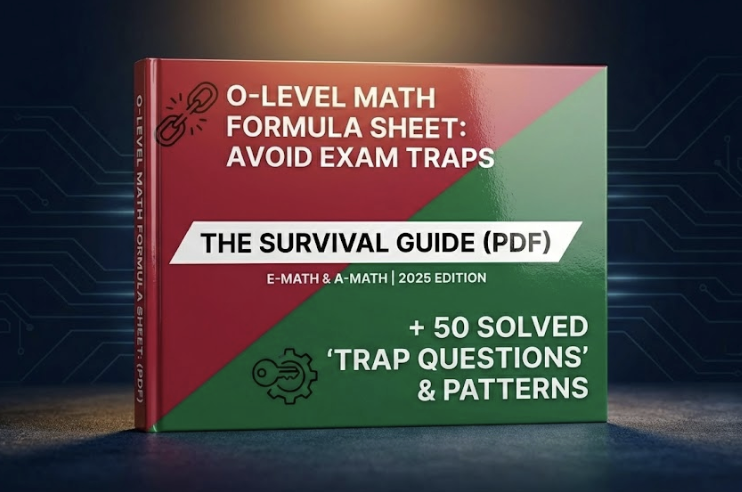
Don’t just memorise the formulas. Learn how to use them.
Download Formula Sheet + 50 Trap Questions ➜
Need More Help?
Join Our O-Level Mastery Class
If you find yourself staring at a question knowing the formula but not knowing how to start, you aren’t missing knowledge, you are missing “Process Skills.”
At Nowa Link Academy, we don’t just teach math; we teach Exam Strategy.